Waking Up at Times Beginning With A “4”

a black photo with the time "4:45" showing in blurry red numbers, as you might see them on a clock radio.

For most of 50 years, I held very firm to the belief that the ONLY time I should ever see a time beginning with a “4” in the morning was when I needed to get up and go to the airport to catch an early flight. Otherwise, any time like 4:30am was just downright uncivil and hostile. I should be asleep at that time. I should NEVER be awake at times beginning with a 4.

And yet… here I am writing this post at 4:55am. 🤷‍♂️

What happened? Well, our dog got older! (And I might have, too.😉)

For some context, I have always been an early riser. Ever since I was a child.

But for the first 35 years of my life “early” was defined as 6:00am.

That was when I woke up. Never at times beginning with a 5, either. 6:00am or later.

I am also one of those people who snaps wide awake and is fully alert and ready to go. No “wake up time” needed. It’s like a light switch where I am no longer asleep – I am now fully awake. And… fully talkative 😀, to the immense annoyance of every roommate I have ever had, including my wife.  (The success of our marriage for 26 years so far is perhaps in part because I learned NOT to talk to her when she wakes up! 🤣)

And then our first daughter was born… and in a bit of karmic retribution, she had the same “instant on and fully talkative” characteristics as me, but she ratcheted the wake up time back to 5:30am! 😀

Suddenly, I was seeing times that began with a 5!

Seven years later, our second daughter was born and she continued the progression by getting up even earlier, closer to 5:00am!

And so it was for many years until they hit teenage years and flipped to wanting to sleep in later. (They are now 20 and 13.)

By that time, however, I was stuck with a body that had now adjusted to waking up in times beginning with a “5”.

Still, times with a “4” were only ever to be for airport trips!

Then, starting about five years ago or so, our dear dog started to wake up increasingly early and want to go outside. At times like 4:30am!

At 15 years old, she’s still in great physical condition, prancing around sometimes like she is MUCH younger. But… when a girl’s gotta go… someone has to let her outside… and due to the aforementioned “instant on” capabilities, that someone is… me. 

We’ve tried all sorts of things to see if we could get her to just wait until maybe a time starting with a “5”. We kept her up much later. We changed feeding schedules. We let her out very late in the evening. (Okay, which for us.. “very late” means 10pm 🤣)

Nothing worked. She still gets up sometime between 4:30 and 5:00 am.

So here I am! Wide awake, alert, enthusiastic… at a time beginning with a 4!


The Single Biggest Thing Preventing Me From Doing More Writing Is…

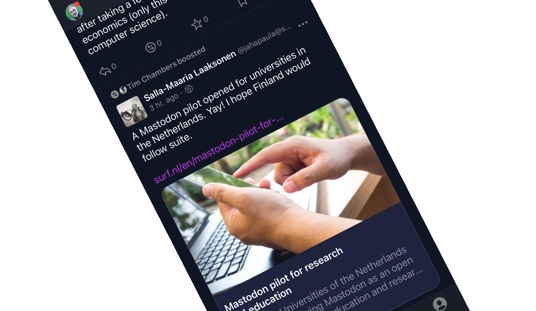
screenshot of a mastodon client running on an iphone. Screenshot is tilted to the left on a white background. The client is in dark mode and so is mostly black. One of the posts shown in the client includes a photo of two hands in front of a keyboard.

As I’ve frequently lamented in my yearly themes (although not this year), I would like to get myself to write more. And back on December 1, 2022, I tried to commit to #100DaysOfBlogging, but that hasn’t worked out so well.

I’ve been watching how I spend my time lately, and to I’m sure the surprise of absolutely NO ONE, including myself, it would seem the single biggest thing preventing me from doing more writing is… getting distracted by social media! 🤣🤣🤣

Take this morning. I was awake early at around 5:00am (courtesy of our wonderful but early-rising dog) and I sat on our couch drinking some tea and browsing through Mastodon (you can find me there). About 1.5 hours later, I’d read some great commentary, found some new articles to share, engaged in some conversations, and generally had an enjoyable time interacting with people.

But… could part of that time have been better spent getting some writing done?

I struggle with this, because on the one hand I learn things from social media that are then useful in new articles or other work. It’s “research” of one form. And engaging with people in an online community is a good thing to do.

But on the other hand, I find myself doing this a bit too much.

I’ll note, of course, that THIS IS NOT A NEW ISSUE FOR ME! In fact, I can easily scan my archives and find I’ve been writing more or less this same kind of post for ** 15 years **! 🤦‍♂️

The common theme through all of that is… “I’ve got to change… I’ve got to not get so sucked into <whatever services>”.

And yet I do. 

The siren song of distraction is incredibly strong.

Perhaps this is the thing where I’ll keep shouting about it in the hopes that eventually by saying it enough I will make it happen in my life.

Or perhaps in 2033 I’ll be writing the same basic post again, lamenting how much time I spend with some new service. 🤣

P.S. And I don’t even mention TikTok, which seems to be wired into my brain in a way that whenever I open up the app it is then an hour or so later when I emerge again! (Hence why I don’t open it all that often.)

Listening to Hear Versus Listening to Fix

The word "Listening?" in black on a blue gradient background

In the last six months or so, I have had an unpleasant revelation about myself. I realized that for most of my 55 years of life whenever I’ve been listening to people, I’ve been listening to offer “fixes”, i.e. solutions. You’ve probably done this yourself at some point. The classic example is something like:

Someone: “Ugh.. my legs hurt so much from <skiing | biking | skating | running | hiking | etc.>”

Me: “Oh, that’s rough! You should take two ibuprofen. You’ll feel better!”

There I was, jumping in with a solution and trying to help.

But here’s the thing – they were NOT asking for help! 

They were simply sharing their current condition. Perhaps looking for sympathy or empathy, but perhaps not. Maybe just saying how they were feeling.

An article I read (and now can’t find) clued me in to my errors. A couple of points:

  • If I’m thinking ahead to solutions, then I’m probably only half-listening. I’m not necessarily completely hearing them. I’m hearing enough to send me down the path of thinking of solutions… and so part of my brain is now focused on that instead of hearing all of what they are saying.
  • They may already have a solution. In my example, they may have already taken ibuprofen or something else. They aren’t seeking a solution. They just want someone to listen and hear them.
  • My quick jump to offering an unsolicited “fix” may cause them to NOT want to share anything with me.. as they don’t want a fix!

Once I became aware of this, I realized that I did this all the time… with our oldest daughter away at university… with my wife… with our youngest daughter… with co-workers… with friends… with probably most everyone. 🙁

Part of it is, I think, my natural desire to help people. Part of it is that I’ve just always been a “fixer”.. the person you drop into a situation to figure out what needs to be done … and to get it done. And I enjoy doing that!

But I’ve realized that this is not always appropriate. That often people just want to share.. that they want to “bend an ear” and have someone listen to them. That they’re not necessarily looking for fixes. And that perhaps a better path is to ask before offering a fix.

So I’ve been trying to change. To listen more fully and to just… listen. To close my mind to what solutions might be out there and to just focus on what they are saying. To truly hear them.

I’m trying to have my responses more along the lines of one of these:

Someone: “Ugh.. my legs hurt so much from <skiing | biking | skating | running | hiking | etc.>”

Me: “Oh, that’s rough!”

Me: “Oh, that’s rough! Are you okay?”

Me: “Oh, that’s rough! Are you okay? Can I get you anything?”

And then depending upon the answer and the situation, I may now try to say something more like:

Me: “Do you want an idea that may help? Or are you all set?”

All of that before getting to offering the solution.

It’s a hard path to being a better listener… to simply “listening to hear” rather than “listening to fix”. But it’s a path I’m trying to follow..


The Awesome Clarity of Prioritizing Health

photo of an arm wearing a black winter jacket and blue glove, showing an Apple Watch with "Outdoor walk" on the watch face

There is an awesome clarity that comes when you have very clear priorities – and in my case one of those is my health. As I alluded to in my three words for 2023, I’ve had a couple of recent minor incidents that have brought this home to me.

A key one was back in November 2022 when I went for a routine colonoscopy. Having had colon cancer, this was my three year checkup and all was great. No signs of cancer and everything looked good. 

BUT… they had to keep me a bit afterward in the recovery area until they could get an acceptable blood pressure reading. I didn’t think a whole lot of it, but a few days later when I went to our local pharmacy to pick up a prescription for our daughter, I had to wait for a bit and so I sat down in one of those blood pressure test machines that we often have in pharmacies here in the US.

And.. I had elevated blood pressure!

Not high enough to be in the “Get thee to a doctor now!” category, but more in the form of “Dude! You need to make some changes NOW if you want to be around for a while!

So I have.

I’ve been eating healthier, reducing my sodium intake (such as not eating the pretzels and chips I love to eat), drinking more water, and… a key point… trying to get at least 30 minutes of exercise each day.

Given that I work in a home office and don’t have to go anywhere, it’s tempting on very cold days to just stay inside, but I’ve been forcing myself to leave and go outside.

This health lens has caused me to make some choices:

  • If I have a block of time when I can exercise, but I want to write a blog post or record a podcast episode, I ask myself “Is this due TODAY?” and “will it matter if I do it tomorrow?” If the answer is no (as it usually is), then I don’t do it and go exercise.
  • If I want to listen to a recording of a work meeting I missed, rather than listen to it while sitting in my office, I open the recording on my iPhone and listen to the meeting recording while walking around my neighborhood. This has the added value that I actually focus on what is being said in the meeting rather than being at my desk only half-listening while I look at Slack, websites, email, etc.
  • I have continued my enjoyment of walking at Shelburne Farms, an amazing and beautiful area that I’m lucky to have about 5 minutes away from our house. Living so close, I can time it to fit a good walk in between other things going on in the day. And when it gets lighter (and warmer) I’ll start going in the very early morning again.
  • For days when it’s too cold and windy to enjoy an outdoor walk, I have started going to a local ice skating rink. I’ve figured out how I can drive there, skate for 30 minutes, and then get back home all within an hour. 

In general, I’ve used the lens of “will this help me improve my health?”

Owning an Apple Watch has also been helpful. I’d dismissed the “closing the rings” Activity thing as a silly gimmick, but I’ll admit that there is a certain satisfaction in knowing I hit my daily goals. The Health app is also useful, and tracking my heart rates, sleeping, etc, is all useful.

Thankfully I have a job that is project-driven and so I can shift my work hours around and start earlier or work later so that I can do some of these things during the day. (And I do recognize that this is a privilege that many people do not have when their jobs are tied to specific hours or locations.)

My goal is that by the time summer comes around, I’m hoping to get back into the running I used to do. We’ll see. I need to be walking faster before I jump into the running again.

The good news is that this all does seem to be working. Two months later, my blood pressure is back down to near normal levels and in fact is even reading as “normal” sometimes. I’ve lost a little bit of weight (still have a long way to go). I’ve found that “Hint of salt” Wheat Thins taste pretty much the same as the regular ones – and I’ve learned how much additional sodium is in so many different foods! And I’m feeling a bit better in general.

Amazing what happens when you have that clarity of priorities in making daily choices!

P.S. I’m also playing in a curling league every Thursday night an hour north in Bedford, Quebec, which gives me two hours of movement that can be intense at times if you need to do a lot of sweeping. It’s kind of fun to look at the heart rates recorded by the Apple Watch after a game and see how up and down they can be.

Capturing My Own Memories Of The Internet’s History (and Pre-History)

449160366_memories_of_Internet_history

Last month I boosted a post on Mastodon where an early pioneer of networking relayed an amusing story about shutting down part of the ARPANET during a storm. After I did that, I was asked “@danyork Do you have a similar story from your archive?”

As I said in a reply,I have stories, but none quite so dramatic. Born in the late 1960s, I got involved with the Internet in the mid- to late 1980s at the University of New Hampshire (UNH).  I was not part of the late 1960s / early 1970s group that was involved with the ARPANET.

But I was at UNH before it became part of the Internet. We used BITNET and there was UUCP and USENET around. It was during my years there (1985-1989) that UNH became part of the Internet. I remember it being a Very Big Deal for those of us in the Computer Science program. Suddenly we would be getting “@unh.edu” email addresses and could connect to everyone else on this growing Internet.

And I was involved with BBSs and early “information services” that pre-dated all of that.

Ari’s point struck me, though. There are many of us who were around in those early days of networking who are walking around with many stories in our heads. Stories of the early days. Stories of how things were before we have the ubiquitous connectivity we have today in many parts of the world (but not all!).

There is value in capturing those stories. In part so that others can perhaps understand how things came to be the way they are. Or to learn how things once were. Or to perhaps spark memories in others. Or for the history fans to just read about what people remember.

There is value in writing or recording these stories NOW… before we forget more of them. Before people get too old to communicate – or before people die. Or, as someone I knew once wrote in the prologue of a memoire of his… “before our memories get so good that we start remembering things that never happened!”  😀

So I think I’ll start this for myself. Here. On this site in a new “History” category. I don’t know that any of my memories are particularly dramatic, and may only be of interest to myself and a few others. But I’ll start capturing them, probably in no particular order.

What about you? If you have stories of the early days of networking, can you share them somewhere?


Image: generated by DALL-E 2 with the prompt “memories of Internet history”

With so many “Dan Yorks”, ChatGPT’s interview questions are very generic

three question marks on a blue grey background

After Simon Willison wrote about how accurate questions from ChatGPT were when he asked “I am interviewing Simon Willison. What are some good questions I can ask them?”, I had to give it a try. Simon’s had some questions specific to the areas he works in, web development and open source, so I was curious to see what might be in one with my name.

I was particularly curious because there are so many “Dan York”s out there on the Internet.

Alas, my response from ChatGPT was boringly generic:

I am interviewing Dan York. What are some good questions I can ask them?

  1. Can you tell us about your background and how you became involved in your current industry/field?
  2. Can you walk us through a recent project or accomplishment that you are particularly proud of?
  3. How do you stay current and informed about developments in your industry?
  4. Can you discuss a challenge or obstacle you have faced in your career and how you overcame it?
  5. How do you prioritize and manage your workload and responsibilities?
  6. How do you approach problem-solving and decision-making in your role?
  7. Can you discuss a time when you had to adapt to a change or new technology in your field?
  8. Can you talk about a team or collaboration experience and the role you played in its success?
  9. Can you describe a specific way in which you have contributed to improving processes or efficiencies in your organization?
  10. What are your long-term career goals and how do you plan to achieve them?

This could be for any of the many Dan Yorks who are out there. 😀

(But not a bad set of questions…)

So then I decided to try to be a bit more specific. I next associated my name with my employer, the Internet Society. The results were actually decent questions to ask anyone associated with the Internet Society (but not necessarily directly with me):

I am interviewing Dan York of the Internet Society. What are some good questions I can ask them?

  1. Can you tell us about the mission and goals of the Internet Society?
  2. How does the Internet Society work to promote and protect internet freedom and human rights?
  3. Can you speak to the role of the Internet Society in addressing the digital divide and ensuring access to the internet for all?
  4. How does the Internet Society work to promote and support a free and open internet?
  5. Can you discuss any current initiatives or projects that the Internet Society is working on?
  6. How does the Internet Society collaborate with other organizations and governments to advance internet policy and governance?
  7. Can you speak to the importance of a multi-stakeholder approach in addressing internet-related issues?
  8. How does the Internet Society work to promote and support internet innovation and the development of new technologies?
  9. Can you discuss any challenges or obstacles the Internet Society faces in achieving its mission and goals?
  10. How can individuals and organizations get involved and support the work of the Internet Society?

Next I decided to try specifying the state where I live, Vermont. Maybe there’s another Dan York in Vermont who owns a business, because I don’t, and so these questions were completely off for me. They could be anyone living in Vermont who owns a business:

I am interviewing Dan York of Vermont. What are some good questions I can ask them?

  1. What inspired you to start your business in Vermont?
  2. What challenges have you faced as a business owner in Vermont?
  3. How do you see Vermont’s economy and business landscape evolving in the next few years?
  4. Can you tell me about a project or accomplishment that you’re particularly proud of in your business?
  5. How do you work with other local businesses and organizations in Vermont to support the community?
  6. How do you stay informed and educated on changes in Vermont’s business regulations and policies?
  7. What advice would you give to someone who is considering starting a business in Vermont?
  8. How do you see Vermont’s unique culture and environment impacting your business?
  9. Can you tell me about a specific way your business is environmentally or socially conscious?
  10. How do you see Vermont’s location impacting your business in terms of logistics and transportation?

Just for grins I decided to go directly into associating my name with one of my blogs. The questions are again a good set of generic questions that could be for anyone’s blog:

I am interviewing Dan York who writes the blog “Disruptive Conversations”. What are some good questions I can ask them?

  1. Can you tell us about your background and how you got started writing the “Disruptive Conversations” blog?
  2. What is the main focus of your blog and what topics do you typically cover?
  3. Can you share some of your most popular or impactful blog posts and what you think made them successful?
  4. How do you stay current with the latest trends and developments in the industry you write about?
  5. What are some of the most common challenges you face as a blogger, and how do you overcome them?
  6. How do you engage with your readers and build a community around your blog?
  7. Can you discuss any notable collaborations or partnerships you’ve had as a result of your blog?
  8. How do you measure the success of your blog, and what are your goals for its future?
  9. How do you stay motivated to continuously write and publish quality content on your blog?
  10. Can you share some tips for those who are interested in starting their own blog or writing content?

And that was as far as I decided to go.

All of these, though, are useful sets of questions. If someone were looking to do an interview in these areas, the questions are not a bad place to start.

Interesting to see various uses of ChatGPT.

My Themes for 2023

A mindmap showing "2023" in a white box on the left and then three branches: Health, Community, Music

As has been my practice for the past 14 years (see list), my first post of 2023 across all my sites is of three words that are my aspirations or “themes” for the year ahead. They are not “resolutions” so much as guiding thoughts or principles.

Health

Health (or a health-related word) has been one of my three words in 11 of these 14 years. 🙁 BUT… the truth is that I’ve reached an UNhealthy point where I MUST prioritize caring for my body. I’ve had a couple of minor health scares. I’ve been too sedentary. And I’ve continually made some poor choices in food consumption (but… all… those… cookies!!). I need to lose a significant amount of weight and I need to get exercising again. I don’t want to be one of those mid-fifties guys who drops dead while mowing the lawn! And.. we have two amazing daughters and I’d like to be around to see where their lives go… and I’d like to grow old together with my wonderful wife. So my health MUST be a priority… really at the expense of all the other things.

Community

The current chaos and drama at Twitter has highlighted how important an online community can be (or in truth a combination of many individual online communities). Many of us are now trying to figure out where the next communities will be. This theme will also be an important part of my work at the Internet Society this year, as I’ll be taking on a new role co-leading a project seeking to help grow “sustainable technical communities” around the world. We’ve seen over the years that where there is the strongest and most resilient Internet access, there are strong communities of technical people. They might be network operator groups (NOGs), or security-focused groups, or other user groups. Helping identify where technical communities are – and where they are not – and helping share best practices among groups will be a substantial part of my work in 2023.

Outside of work, this word and theme plays into other aspects of my local life. I’ve been getting more involved in some activities in my local town. I’m also in the leadership track for our local Rotary Club and in July I’ll become the President of the club. I’m also involved in other global communities such as the IT Disaster Resources Center (ITDRC) and of course the Wikipedia editors community.

“Community” – and building thriving communities – is SO important in all that we do.

Music

This is a theme I haven’t included before, but over the past year of returning to some activities, including singing in a church, I have realized how much I have missed music being more of a role in my life. In 2022 I started to take some guitar classes again, which I’m hoping to continue in January. I’ve also started to do a bit more noodling around on the piano… and may actually think about some lessons somewhere in here. And, at some point in time I’d like to do some singing with a group, something I haven’t done in a couple of decades. We’ll see.

Missing from the list this year is the nearly ubiquitous “Content”. I didn’t create a great amount this year, and I’m hopeful that I will do more in 2023… but I’ve come to terms more with the reality of everything else going on. Creating content will not necessary be a “focus” area, but hopefully may be an outgrowth of some of the other work. But whatever happens, I’m not going to stress about it too much.

That’s what I’m looking forward to this year. How about you?

Hallmark Christmas Movie Bingo Cards – and the Fascinating History of the Hallmark Channel

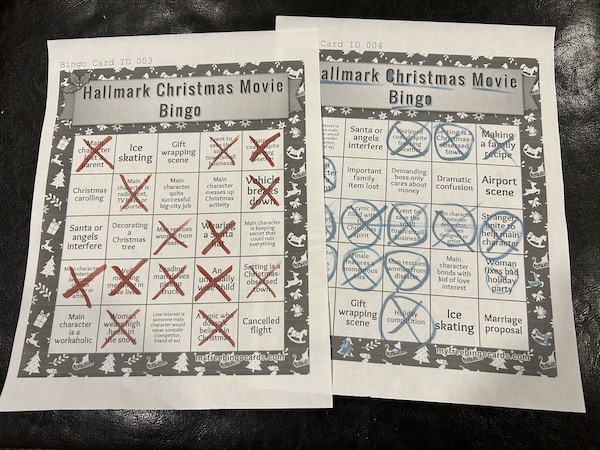
Two printed bingo cards for Hallmark Christmas moviesThis past holiday weekend our older daughter brought a new fun activity – “Hallmark Christmas Movie Bingo”. If you are familiar with the “Hallmark Channel” here in the USA, they produce many seasonal romance movies. They vary widely in quality and some are a bit cheesy and cringe-worthy. Many of the movies follow a common formula … something like… high-powered marketing exec in New York City finds out her fiancé is cheating on her, and so goes away to spend Christmas with one of her old friends at her house in some rural location (often Vermont). While there, something happens (car breaks down, big town event is in chaos), and she meets some hunky man who she is initially repelled by… but by the end of the movie they are either kissing, getting married, or she is leaving her job in New York to relocate to this ideal life in the rural town. Or something like that. Usually the main character seems to be female, although I’ve seen a few male. Often they are cynical and think Christmas is just a consumer spending experience.

Anyway, this formulaic production model turns out to be perfect for a bingo card. Here are just some of the squares on one of the free sites that offer these cards:

  • Trip to a Christmas tree lot
  • Main character is a single parent
  • Main character is a workaholic
  • Setting is a Christmas-obsessed town
  • Characters pretend to be dating/engaged
  • Town’s major industry/historical landmark/major tradition is in peril
  • Character from the big city grows to love small-town life
  • Unexpected help from angel/Santa
  • Main character is keeping secret that could ruin everything
  • They lost their Christmas spirit when a parent or spouse died
  • Reliving Christmas traditions past helps renew someone’s Christmas spirit
  • Love interest comes to her rescue by doing something manly
  • Cute dog
  • Delayed flights

You get the idea.

It was a fun addition to watching the movies – and quite honestly kept me watching one very cringe-y and unrealistic movie when I might have just left the room to do something else. Hallmark staff clearly understand this, as they have written about it, and even sell a bingo kit. There are, of course, many free sites offering such cards.

What fascinated me, though, was to learn a bit more about the Hallmark Channel itself. A Wikipedia article traces its history from its origins in the late 1980s and early 1990s with two religious cable channels. These combined to become first the “Faith and Values Channel” in 1993 and then the Odyssey Network in 1996. In 1998, Hallmark Entertainment and The Jim Henson Company (think of the Muppets) became investors and the channel further reduced its religious programming to focus more on “family” shows.

In 2000, the ownership structure changed and in 2001 it was rebranded as the “Hallmark Channel”. The Wikipedia article goes on to detail the evolution of the channel, including the involvement of both Hillary Clinton and Martha Stewart at different times – things I was not aware of – as wall as the development of the seasonal content that many of us may be aware of today. I also was not aware of all the animal programming, although that makes sense in the context of their historic “family friendly” programming.

The article also notes some of the Hallmark Channel’s struggles between its more conservative origins and the more inclusive society we are in today. And noting the evolution of the channel to include LGBTQ characters or stories.

I seldom watch the Hallmark Channel myself, and I don’t know that this weekend’s experience will change that, but it was an enjoyable way to spend some time together – and it was interesting to learn of this larger history.

The Christmas Story, As Told by ChatGPT in Iambic Pentameter

the text "An AI christmas story" on a red and green gradient background

For those who celebrate Christmas, as I do… MERRY CHRISTMAS! 

As I am off celebrating the holiday with my family, I thought I’d ask an AI to tell the Bible’s Christmas story. So I went to ChatGPT and asked:

> Tell the biblical Christmas story in iambic pentameter

Why iambic pentameter? I don’t know… other than thinking it could be more interesting than just having Chat GPT regurgitate blocks of text. This requires a little bit more effort.

After getting the first version, I found the focus on Herod to be a bit odd, so I pressed the “Regenerate response” to get a second version. Then I did it three more times, and decided to include all five versions here. I find the differences very interesting, as each takes a different view on the story, and includes or excludes different aspects of the story. For instance:

  • Herod, Egypt, and Nazareth only show up in version 1.
  • The shepards only appear in 2, 3, and 4.
  • The wise men are only in 2 and 3.
  • Gold, frankincense and myrrh only appear in 2.
  • Angels only appear in 3 and 4.
  • Version 5 has almost no details but instead focuses on the religious meaning.
  • None of them mentioned why Joseph and Mary where traveling (to register for a census in his home town for tax purposes for the Roman government).

It also shows that you can’t just take ChatGPT’s answer as gospel (quite literally). Imagine if you asked ChatGPT and got only version 1? You would have a very different view of the story from the other ones.

No matter which story you may or may not agree with, including none of these, I wish you all a very merry Christmas!


Version 1

Once in the land of Judah, long ago
A virgin fair was betrothed to Joseph, a carpenter
But in her womb, a child was set to grow
Conceived by power of the Holy Ghost, as told by angel Gabriel

This child would be the savior of us all
A king, descended from the line of David
His birth had been foretold by prophets tall
And now, the time had come, the promise given

But in the land, a ruler did hold sway
A cruel and wicked man, by name of Herod
He heard the news of this newborn king at play
And in his jealousy and fear, did order

That every male child, two years and under
Should be put to death, in Bethlehem and near
To try and kill this child, the Son of Thunder
But Joseph took Mary and the babe in fear

And fled to Egypt, till the danger passed
They stayed in hiding, till the coast was clear
Then returned to Israel, at last
And settled in a town called Nazareth

Thus Jesus grew, in wisdom, age, and grace
And when the time was right, he took his place
As savior of the world, in love and peace
This is the story of the birth of Jesus, the Prince of Peace.


Version 2

In Bethlehem, a city of Judea,
A child was born, the savior of mankind.
This infant, wrapped in swaddling clothes so new,
Was laid in manger, for there was no room
In inns of Bethlehem, on that holy night.

The news of this great birth was quickly spread
To shepherds in the fields, who did not stay
But hurried to the stable, where they found
The newborn king, lying in a bed of hay.

The shepherds marveled at the sight they saw,
And they returned to their fields, praising God
For sending them the savior of the world.

But news of this great birth was not confined
To shepherds in the fields or Bethlehem's town.
Three wise men, guided by a shining star,
Came from the East, bearing gifts of gold,
Frankincense, and myrrh, to honor him.

And so, on this most holy night, the world
Was blessed with the arrival of the one
Who came to save us all, the son of God,
Jesus, the Christ, the savior of mankind.


Version 3

In Bethlehem, a town so small and poor,
A child was born to Mary, pure and fair.
This blessed babe, the Son of God, was sure
To bring salvation, love, and mercy rare.

The angels sang, and shepherds came to see
This newborn king, in stable low and mean.
Three wise men, led by a bright star, did flee
To offer gifts, and worship on their knees.

This holy child, so pure and innocent,
Was sent to save us all from sin and death.
He lived and loved and healed with great intent,
And willingly submitted to his earthly death.

But death could not contain him, as was plain,
For he rose again, and lives forevermore.
He brings salvation, hope, and joy, and reigns
As Lord of all, forever and always.


Version 4

The Christmas story, as told in the Bible,
Is one of joy and love, a miracle true:
It starts with Mary, chosen by the Lord
To be the mother of His only son,
A son who would redeem the world from sin.

The angel Gabriel appeared to Mary
And told her she would bear a son, and he
Would be the savior of the world, a king
Descended from the line of David, great.
Mary, though frightened, knew that this was right,
And so she said, "I am the Lord's servant.
May it be to me as you have said.”

The time came for Mary to give birth, and so
She and her husband Joseph traveled far
To Bethlehem, the city of David's birth.
But when they arrived, they found no room
In any inn, and so they had to stay
In a stable, where the baby Jesus lay.

The shepherds, watching over their sheep by night,
Were startled by a bright and shining light,
And saw an angel, who told them the news
Of Jesus' birth, and said, "Do not be afraid.
I bring you tidings of great joy today:
A savior has been born in Bethlehem, a boy.”

The shepherds went to see the baby Jesus,
And when they saw him lying in the manger,
They knew that this was the son of God, and so
They spread the word throughout the countryside.
And so it was that Christmas came to be
A day of joy and celebration, free
From sin and sorrow, as the world rejoiced
In the birth of Jesus, our beloved Lord.


Version 5

The Christmas story, as told in the Bible, is a tale of hope and redemption. It begins with the birth of Jesus, the Son of God, in a humble stable in Bethlehem.

Joseph and Mary, betrothed in marriage,
Were traveling to the town of David's line
When Mary, heavy with the child she'd carry,
Was forced to stop and give the baby time.

And so, in poverty and low estate,
The Son of God was born, a lowly king.
But though His birth was humble and sedate,
His purpose was to save the world, and bring

Salvation to all those who would believe.
For He was sent to be the sacrifice,
To bear the weight of sin upon His sleeve
And through His death, bring us to paradise.

And so the Christmas story, full of grace,
Brings hope and joy to all who seek His face.

Ceremonies of Light and Dark

Fire in firepit

I have always enjoyed our ceremonies of light and dark, here in the cold mid-winter of northern New England.

The winter solstice here is always a time of celebration. For us, it is the shortest “day” in terms of daylight – and the longest night. It is cold here at this time of year.

The solstice gives us hope. From here on out, the days only get longer… and at some point will start to actually get warmer. (We have to go through some much colder periods first, though!)

We celebrate here so often with candles… with fires… with flames… with light to drive away the darkness.

In the Christian tradition, there are the candles of advent, the Christmas trees with their lights, and… today… the many lights that people decorate their houses with. In the Jewish tradition, there is the menorah with its 8 candles that are lit during the days of Hanukkah. In older pagan traditions, there were similar ceremonies of light. Today, in our less religious times, we cover our houses with “holiday lights”. In a school our daughters attended when they were younger, there was a beautiful advent spiral walk with candles.

Many of the ceremonies have different meanings, of course,

Yet each in their own way brings light into a time of darkness.

There is beauty and magic in that.